Tuesday, October 9, 2012

Cross your fingers & hope it was made in the U.S.A.


In Communication Power, Manuel Castells asserts that while advances and revolutions in communication technology are crucial to the evolution of communication, actual consequences applicable in the everyday world arise from “policy decisions that result from the debates and conflicts conducted by business, social, and political interest groups seeking to establish the regulatory regime within which corporations and individuals operate” (99). One such decision just may be in the works. A little-known Supreme Court case (Kirtsaeng v. John Wiley & Sons) is calling attention to the first-sale doctrine in copyright law, “which allows you to buy and then sell things like electronics, books, artwork and furniture, as well as CDs and DVDs, without getting permission from the copyright holder of those products” (read more about the case here). Perhaps increasingly so in the age of information explosion we live in today, it seems that Intellectual Property Rights (IPR) becomes frequently enmeshed in the decision-making that drives and transforms the arena of communication. IPR protection is a top priority for diplomats of countries whose industries and economic interests are seriously threatened by violations, and even take on importance traditionally reserved for high-profile political negotiations. Times have changed, and it’s common knowledge that illegal acquisition and duplication of intellectual property abound in countless corners of the world—and the neighborhood. This isn’t just some faraway street vendor in Cambodia selling the latest Hollywood blockbuster practically as it’s being shown in theaters in L.A. It affects us at home, lending weight to Castells’ point that “societal communication is a practice regulated by political institutions in all countries because of the essential role communication plays in both the infrastructure and culture of society” (99). 

Depending on the Supreme Court ruling on Kirtsaeng v. John Wiley & Sons, businesses like eBay and Craiglist might receive some heavy blows—but perhaps more importantly, we may no longer be able to sell your textbooks back online at the end of the semester. Beyond the rights and wrongs of Kirtsaeng v. Wiley, the implications are huge. That IKEA desk you’re trying to sell before moving to your new pad? Or even those jewels passed down from your great-grandparents that was made who knows when and only God knows where? If the Supreme Court indeed rules that products made overseas are not applicable to the first-sale doctrine, the hassle in acquiring permission from the original copyright holder may be more than the worth. It could affect pricing, too, since rights holders might then want a piece of that sale, and in a stranger outcome, the ruling could even encourage manufacturers to produce everything overseas in the hopes of controlling every resale. Kirtsaeng clearly couldn’t have made $1.2 million from innocently reselling just the textbooks he personally used, and the first-sale doctrine indeed deserves questioning and reshaping to better accommodate the changing information and communication landscape of the 21st century. But as individuals, the impact of policy that may seem personally inconsequential at first glance can be shocking on second look. And at the same time, it gets you thinking about another one of Castells’ assertions; that regulatory policies are the “result of power-making strategies through the articulation of business and political interests, dressed up in discourses about technological wonders and consumer choice” (107)...

Monday, October 8, 2012

Global Info. Infrastructure & Public Diplomacy


"To meet these 21st century challenges, we need to use the tools, the new 21st century statecraft. ...we find ourselves living at a moment in human history when we have the potential to engage in these new and innovative forms of diplomacy and to also use them to help individuals be empowered for their own development."
- Secretary of State Hillary Rodham Clinton

          Over the past two decades, digital communications between both people and organizations have significantly increased. Manuel Castells terms this the “network society [in describing] the impact of new information and communications technologies on different levels of interaction in society”. In this new society, citizens “have become increasingly empowered to participate actively in the public sphere”. The general public on all levels now has control over the public sphere, not solely the traditional mass media outlets.
The U.S. Department of State decided to act on this shift by enacting digital diplomacy, a way of using new technologies to reach out to various non-state actors. Secretary of State Hillary Clinton spoke on this in October 2010 with her speech on Innovation and American Leadership. She spoke on how using tools of technology to expand the role of diplomacy worldwide is necessary for this new digital age. The bureaus at the Department of State, including Public Affairs, E-Diplomacy, Public Diplomacy, International Information Programs, etc. all utilize media platforms to engage and empower citizens both abroad and in the U.S. Each regional office and embassy utilizes these as well, using Twitter feeds, Facebook pages, Blogs, and various other platforms to engage. This culture change in the Department of State shows just how important these new platforms are for governance. President Obama enforced this as well with his Digital Government initiative to “better serve the American people in building a 21st century platform”, combining web platforms with mobility issues. 21st Century Statecraft, as they term this shift, is currently promoting innovation to realize the full potential of these new technologies.
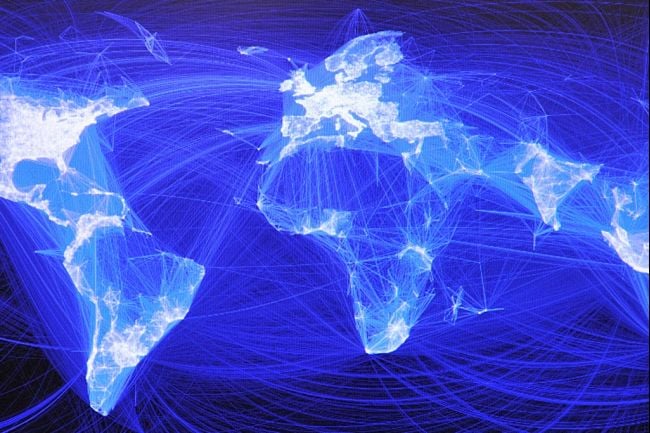
In Seo and Thorson’s network analysis on the structure of global Internet connectedness in Networks of Networks: Changing Patterns in Country Bandwidth and Centrality in Global Information Infrastructure, 2002-2010, they show the linkages between many nations in terms of bandwidth levels and centrality in connections with other nations. Predictably, the U.S., U.K, Germany, France, Italy, Singapore, Netherlands, and China all had the most advanced Internet networks. The Middle East and North African countries were shown to have increased as well, progressing to the center of the global Internet network. As these countries inch closer to the center, they become directly connected with the more technologically advanced nations.
Seo and Thorson go on to explain that “countries that use these technologies effectively will, ceteris paribus, gain long-lasting and growing advantages if they do so sooner rather than later”. This explains the rapid increase in online social networking and information technology in U.S. diplomacy objectives. Through the combination of new public diplomacy initiatives with the use of new technologies and the increased connectedness of countries throughout the world, global relations have already begun to change. In order to be strong actors in this new “networked society”, all nations need to realize the full potential new technologies bring and the importance of using them to directly connect with one another. Otherwise, they'll be considered too "traditional" for the globalized world.


Photograph by the Foreign Policy Association


Sunday, October 7, 2012

I'm not sorry


While reading Mattelart’s mostly pro-piracy article “Audio-visual piracy: towards a study of the underground networks of cultural globalization,” I couldn’t help but begin to think of my own concern when Piratebay.org is shutdown from time to time for (no more than) three days. Piratebay.org is a prime example of functioning, modern-day digital-piracy. It works through torrents, a file needing an external extracting software, such as Transmission. A huge file such as a movie or an artist’s new album can be downloaded in a torrent format to a computer, then extracted through such a software as Transmission, then opened and enjoyed. It works swimmingly.
After a recent three-day shut down, the Swedish operators of Piratebay began a new format of downloading in order to make tracking of its sources more difficult: magnet files. This arguably makes digital piracy easier. By clicking on a small magnet icon, the file skips the downloading phase and is immediately linked to any available extraction software on a user’s computer. The files function faster according to how many users “seed” (or share) the files online.
Maybe at one point I was a naively concerned consumer of media, worried that my favorite artists would lose so much money due to illegal downloading that they’d stop making music altogether. As I got older and progressively poorer, this fear seems to have almost completely dissipated. Any remains of it were effectively destroyed thanks to Manueal Castell’s affirmation that “online advertising accounts for almost $36 billion in revenue” (Castells, 80) and, “Major advertisers are also investing in scripted online branded content… Disney had one of its films written into an episode of KateModern,” (Castells, 81). Fortunately for artists and entertainers, product placement is all over the place and what those artists lose in sales of physical CD copies and paid digital downloads they make up for in increased online advertising, huge world tours more accessible as the years go on, and their ability to expand into other markets thanks to the “economic synergy” and expansion of multi-media conglomerates. Lady Gaga just created an eau de parfum called “Fame” that she has used her own personal media corporation, The Haus of Gaga, to promote across all sectors of media: her music, her videos, concert tours, public appearances aired on TV, etc.
The clear success of artists and the amount of money they make might even be a result of the dissemination of their art on the Internet and across the globe due to piracy. This also allows creative talents that have yet to be discovered spread their art cheaply, and those talents are thus given a chance to succeed due to illegal downloading.
Some artists, such as rapper Lil’ B, give their music out for free. Lil’ B’s satirically titled album, “IM GAY,” was made available for free legal download everywhere on the web. Mattelart notes at the beginning of his article that media conglomerates have a hard time proving the specific numbers they dish out in claims that the media has lost billions upon billions of dollars due to piracy, but even if that’s true, I’m not so sure I feel bad for them. I think the artists ranking in millions of dollars, such as Britney Spears’s $15 million dollar paycheck for appearing as a judge on X-Factor, are doing just fine. 

Wednesday, October 3, 2012

A Rift in Global Media Governance?


Is there an expanding rift in global media governance?  In the Thussu reading "Creating a global communication infrastructure", it appears that the direct correlation of increasing de-regulization and privatization is causing  a major impact on international communications.  In countenance to this, the increase of pro-market international trade regimes has led to the strong competition between companies and private networks, such as global-media outlets (i.e. Rupert Murdoch's News Corporation company) who compete for visibility, and to maintain consistent audiences, viewers, and readers. Following the trend of global media's history, only within the last three decades have global media companies emerged since the relaxation of political institutions, and individual countries regulations on communication tools and technology.

This has provided an enormous amount of opportunity for 'societal communication' (Castells, 99)  to grow exponentially.  For example, one form of global media broadcasted via wireless & satellite communication are classic American TV shows, like The Simpsons and American Idol by the Fox Network, or  fairly new ones like Top Model and Gossip Girl by the CW Network,  which can be watched or streamed by viewers all around  the world.  Additionally, companies such as News Corporation (American-owned), Hong Kong's Asia TV, and the UK's Sky TV, referenced in the Thussu reading, manage wide-ranging media/ TV-broadcasting services transnationally; and in multiple languages to reach viewers of various backgrounds.


However, the number of global media companies with a worldwide presence on two or more continents is strikingly scarce. This in part is due to company interests in meeting demands, but also due to global media outlets  trying to  gain more ground in terms of exposure. Visibility, and the ineffectiveness of global neutrality in regulations for all international media outlets are the most distinct causes.  Many companies and private networks are competing with one another, but are also restricted in abiding by their countries regularized polices. This might be a major reason for the one-sidedness of American audiences viewing majorly American-based TV shows and not being offered a fair, or equivalent amount of exposure to foreign-based TV shows. Even though the American people are aware of foreign-based TV shows, there is a one-way relation import, or availability and access to these shows outside of streaming  foreign shows online.  Realistically speaking, if Vietnamese teenagers are able to watch translated shows, such as American Idol at home on their TVs, why aren't American teenagers able to watch translated Vietnamese TV shows on theirs?  

It seems as though there is a an exceptional rift in global media governance, created alongside with the explosion of global media companies, and the technological and cultural transformation of communication.  As de-regulations and liberalizations were made by political institutions and countries, the rift in global media governance grew. Whether, or not the rift will decrease in the coming years remains to be seen.  Although, it certainly remains true that the competition between companies and private media networks for audiences and viewership will remain strong.  So, in order to gain a 'piece of the pie' as some would say, smaller global media outlets must make a demand for more equal rights in media regulations domestically & internationally, try to make use of their limited resources, and promote or advertise broadcasted TV shows that might have the potential to appeal to all audiences and people of diverse backgrounds. 


Citations:

Manuel Castells (2009), Communication Power. Oxford, New York: Oxford University Press.

 Daya Kishan Thussu, chapter called "Creating a global communication infrastructure".

Simpsons Family Photo retrieved from: http://crazy-frankenstein.com/the-simpsons-family-pictures.html.

Tuesday, October 2, 2012

Will we see 'Morphology of Ideoscapes' at FSI?


In the recent aftermath of the killing of the U.S. Ambassador to Libya and attacks targeted toward American embassies around the world, many a debate has taken place on the words tweeted by Embassy Cairo in reaction to escalating tensions. Presidential candidate Mitt Romney offered his high-profile two-cents, and news stations around the world have scurried around to recruit commentators to analyze the issue. The situation and reactions surrounding Embassy Cairo’s official social media communications exemplify Appadurai’s call for an “urgent analysis” of how both spoken and written words are received by different audiences:

“So, while an Indian audience may be attentive to the resonances of a political speech in terms of some key words and phrases reminiscent of Hindi cinema, a Korean audience may respond to the subtle codings of Buddhist or neo-Confucian rhetorical strategy encoded in a political document. The very relationship of reading to hearing and seeing may vary in important ways that determine the morphology of these different ‘ideoscapes’ as they shape themselves in different national and transnational contexts. This globally variable synaesthesia has hardly ever been noted, but it demands urgent analysis.”

Surely the kind of analysis Appadurai demands is not only for the careful among oratorical strategists of presidential candidates. In fact, where this attention is needed most is perhaps right before that Foreign Service Officer hits “submit” on a blog post, Facebook comment, or (drumroll, please) an ever-dangerous tweet. This is in no way intended to undermine the efforts already being made to advance our ability to conduct effective outreach to foreign publics, but is rather merely another case to be made for incorporating nuance into the public diplomacy machine…via more than just a nuance. Does this mean we need a new class on “Message Crafting and the Morphology of Ideoscapes” at the Foreign Service Institute? Should there be new evaluation methods for recruiting Public Diplomacy tracked Officers? I have no idea. At least not yet. But let’s say that’s because I’m still “only” a graduate student with lots left to learn…like how to carefully tread the waters of public expression online. Who knows? Maybe this blogging assignment will be the one thing standing between me and a twitter blunder I’d hate to commit.

Bollywood's Seeping into Afghanistan


If you look closely at this Bollywood music video, you’ll notice the many scarves worn by the main singer, Salman Khan, and his entourage:

 The video has recently gone viral in Afghanistan, a preview to the movie Ek Tha Tiger. As a result, Khan’s neck scarves have become a prominent fashion accessory throughout the country.
            A Washington Post article stated how this hasn’t been the only globalized trend reaching Afghanistan. Gelled hair and new clothing styles, including women wearing half sleeves on their dresses, have emerged as a result of the Bollywood movies. Businesses are onto the trends as well, instantly importing the actors/actresses’ styles when the movies debut.
            Bollywood movies in this part of the world did not appear by chance. India has been the largest regional donor to Afghanistan’s reconstruction, having spent $1.5 billion over the years and having recently signed a strategic pact to help train Afghan security forces.
            This is a prime example of how technologies and economics are interconnected through globalization. Arjun Appadurai explains this with his idea of “scapes” in Disjuncture and Difference in the Global Cultural Economy. He believes that a “global cultural flow has occurred” in the connections of all aspects of globalized societies – ethnoscapes, technoscapes, financescapes, mediascapes, and ideoscapes. The scarf trend in Afghanistan relates to the connection between economic globalization and the mediascape, defined as the “distribution of electronic capabilities to produce and disseminate information” and the images these capabilities produce. As economic aid from India has increased, so has the popularity of Bollywood films.
            Appadurai then focuses on the audience’s reaction to these new media images. When the audience sees a Bollywood movie, “the lines between realistic and fictional landscapes they see are blurred”, especially if they are far away from “the direct experiences of metropolitan life”. This is playing out in Afghanistan, where some women are wearing dresses with shorter sleeves and men are gelling their hair, mimicking the singers as if they were in the video too. Appadurai further explains cases such as these as “imagined worlds” made up of a mixture of the audiences’ personal values and the perspectives they infer from the media images.
            This mixture of core values and new perspectives affects the community differently. While many are seeing Bollywood as a fashion outlet, others see it as “an erosion of the Islamic ways as people reject traditional dress to keep in step with Bollywood and Hollywood”. The women with the shorter dress sleeves are occasionally criticized. A group of men were pulled aside by the police to have their gelled hair cut off. While many strongly reject globalization, no one can fully escape its effects. The Taxi driver who stated the above quote exemplifies this perfectly: his head was wrapped in one of those trendy scarves while he made his remarks.
            The effects of globalization will continue to show as the “scapes” of different societies become more connected. Individuals will react differently to these changes, as shown with Bollywood’s images populating Afghanistan, but they will eventually have to adapt.
       

Monday, October 1, 2012

Cultures and Perception


[i]
“Among Muslim women, the debate about hijab takes many forms. Many believe that the veil is a way to secure personal liberty in a world that objectifies women. Several women have argued that hijab allows them freedom of movement and control of their bodies. Understood in such terms, hijab protects women from the male gaze and allows them to become autonomous subjects. Others have argued that the veil only provides the illusion of protection and serves to absolve men of the responsibility for controlling their behavior.” [ii]
     As the global media has spread, there has been a clash of cultures and cultural ideals throughout the world.  The globalization of cultures through the media, has allowed people to identify, internalize, and scrutinize varying aspects of a culture without having to be within the borders of a nation or a part of that culture. This can be seen through the argument over the hijab and the rights of women. The front cover of the Time’s magazine from December 3, 2001 shows a woman in a hijab and the title states, “Lifting the Veil: The shocking story of how the Taliban brutalized the women of Afghanistan. How much better will their lives be now?” The cover of Time shows the contradiction between Western values and Arab culture. The justification of Western values over those of Muslim was prominent in this article. One of the arguments was that the hijab, to a Western audience, was a prohibiting entity which banned women from expressing themselves. Although it is undeniable that certain rights of women were suppressed by the Taliban regime, the fight to abolish the hijab was met by stark opposition both within the United States and abroad. To many Arab communities, the fact that many Western women, especially American women wear revealing clothing is considered oppressive. This cultural difference has come to a head in France where the government has recently banned the wearing of the hijab.
     The simple fact is that whether they are forced to wear clothing to cover themselves, or not being allowed to wear the clothing, the rights of these women are being violated and disrespected. When women are banned from wearing the hijab or forced to veil themselves, they are being told what they can or cannot do, which is inhibiting their right to express themselves. The controversy, as the cartoon above demonstrates, is that there is a cultural misperception of right and wrong. From a Western perspective the hijab is a clear sign of a male dominated society. On the other hand, if a woman wants to wear the hijab it is her right to do as she pleases without scrutiny or assumptions of weakness.  For one woman the hijab may be a symbol of oppression, for another a symbol of freedom.


[i] Manawatu Standard of January 7, 2011
[ii] Mernissi, Fatima. Beyond the Veil: Male-Female Dynamics in a Modern Muslim Society. New York: John Wiley and Sons, 1975.